
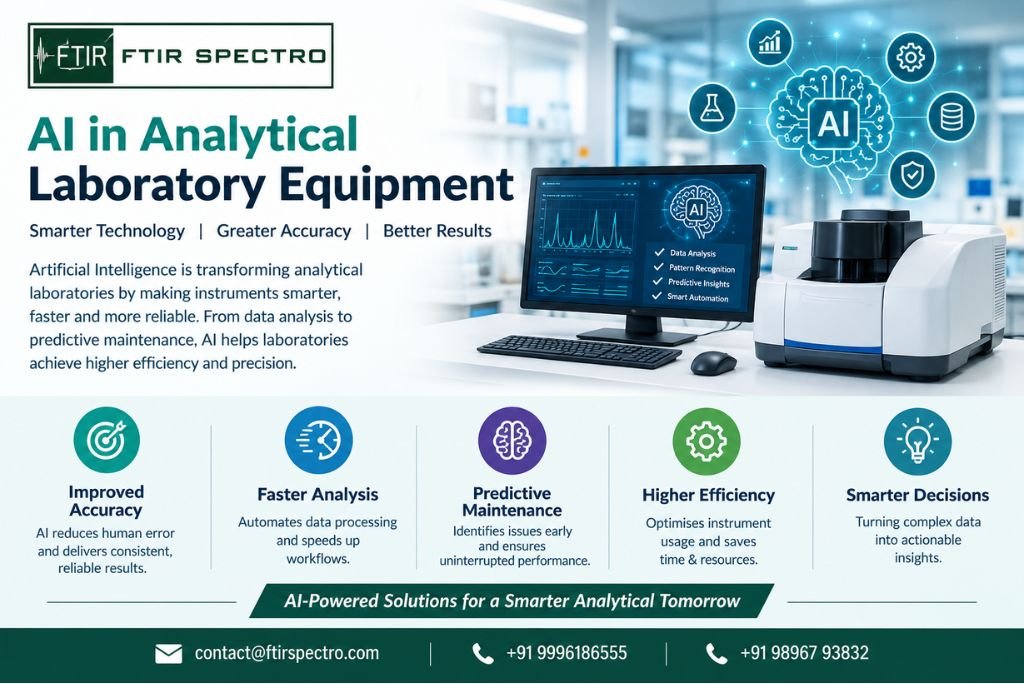
Where is AI going in the analytical laboratory? It’s not taking the place of the scientist. It is assisting laboratories in dealing with the vast quantities of data generated by new instruments. Large amounts of data can be generated by spectra, chromatograms, calibration, or repeated measurements that are hard to go through manually.
That’s why AI is relevant to analytical instrumentation. NIST states that developing metrics for measurement and evaluation of AI systems and evaluation methods and standards for AI systems is a key priority of its current efforts to build trustworthy AI. This makes AI very useful for laboratories: Only as useful as the data and measurement that went into it.
FTIR Spectro, as a reliable analytical lab equipment supplier and exporter, believes it is continuing the trend of analytical testing, but not exactly a new trend.
Artificial Intelligence’s Role in Analytical Lab Equipment.
Often the simplest use cases for AI are tasks that analysts spend time doing repeatedly.
An intelligent system can assist in detecting patterns, classifying test results, identifying abnormal results, comparing data sets, and focusing on data that needs further investigation. This can be very useful in those applications where laboratories handle hundreds of samples a day, rather than a few measurements a day.
Consider a quality-control laboratory. An analyst might need to compare many results with the specifications. AI-powered software can detect variations from the predicted results in a dataset rather than having to look at every one of them individually.
The analyst is still responsible for understanding the method and what the result means. AI is just the tool that facilitates focused attention.
AI and FTIR: Making Spectral Analysis More Intelligent
One of the most interesting applications of AI in the field of infrared spectroscopy is that each test produces a spectrum of data that includes information on a material’s molecular characteristics.
FTIR is a very useful tool in a laboratory for identification of raw materials, comparison of samples, investigation of contamination, examination of polymers, pharmaceutical material analysis, and for research. Intelligent algorithms can be used to aid spectral classification and pattern recognition when appropriate reference datasets are available.
It is especially applicable to us due to the fact that we are specialized in analytical instrumentation and offer pharmaceutical, chemical, food, environmental, research, and industrial applications using FTIR spectrophotometers. We have a larger range of spectroscopy, chromatography, and physical analysis instruments.
It’s not just about faster spectra. It is about simplifying the process of comparing, interpreting, and using those spectra.
The Potential of AI to Transform HPLC and Chromatography.
Another kind of information-rich dataset is created by chromatography.
The HPLC system separates the components before they can be detected, resulting in peaks in a chromatogram that are evaluated by the analyst for retention time, area, resolution, and other characteristics. If the sample volumes increase, it can become repetitive to review all chromatograms individually.
AI-driven data processing can be used to help detect irregular peak patterns, categorize results, and alert an analyst to unexpected measurements.
Our HPLC systems are suitable for pharmaceutical, chemical, food, environmental, and research applications. Depending on configuration, they can operate isocratically or under gradient conditions with flow rates ranging from 0.001 to 10 mL/min and pressures up to 6000 psi, and coupled with various detectors such as UV, PDA, RI, or fluorescence. We also include 190–800 nm coverage for UV/PDA configurations and software compliant with 21 CFR Part 11 in our published specifications.
That’s a lesson to remember: Smart software can be most valuable when supported by reliable analytical hardware.
As far as we’re concerned, the best way to work is:
The reliable instrument uses a controlled method to measure quality and has intelligent data processing and expert interpretation.
It’s not above the chain; it’s in the chain of AI.
Choosing an Analytical Lab Equipment Supplier for an AI-Ready Laboratory
We are an analytical lab equipment manufacturer, which means we cover multiple laboratory analysis streams rather than a single instrument.
When choosing an analytical lab equipment supplier, it’s easy to end up asking yourself, “Does this instrument have AI? Rather, the question should be, what does the technology actually improve?
Consider if the system can facilitate efficient data handling, reliable measurements, traceable data, maintenance, software connectivity, and future system upgrades.
The same goes with the choice of an analytical lab equipment exporter. Other setups, documentation, technical support, and solutions tailored to the application may be required in international laboratories. In addition to its analytical instrument range, FTIR Spectro offers services such as supply, OEM/private label manufacturing, custom products, and technical support for FTIR worldwide.
The Future Is Not AI Instead of Analysts
The future is more realistic: AI with laboratory professionals.
In that model, instruments will provide consistent measurements, software will be used to organise the data, AI will be used to recognize patterns or anomalies, and trained analysts will interpret the evidence.
That is the path we see going forward with FTIR Spectro: not because it is a popular technology, but because the intelligent use of data will simply help analytical work be more efficient without sacrificing measurement quality and scientific judgment.
The actual challenge for modern laboratories isn’t the decision to opt for human input AI but rather to strike a balance between the two. It’s about creating analytical systems where the right instruments, the right data, and the smartest software co-work.


